Table of Contents
ToggleAI hardware vs software represents one of the most important distinctions in artificial intelligence today. Both components work together to power AI systems, but they serve fundamentally different roles. Hardware provides the physical processing power. Software delivers the intelligence and logic. Understanding these differences helps businesses and developers make smarter investment decisions. This guide breaks down what each component does, how they differ, and when to prioritize one over the other.
Key Takeaways
- AI hardware vs software represents different roles: hardware provides physical processing power, while software delivers intelligence and logic.
- Specialized AI hardware like GPUs, TPUs, and ASICs handles parallel computations far more efficiently than traditional CPUs.
- AI software—including frameworks, pre-trained models, and inference engines—determines what an AI system can actually accomplish.
- Software offers more flexibility and faster update cycles, while hardware requires significant upfront investment and physical replacement for upgrades.
- Prioritize hardware for large-scale model training, real-time edge applications, or high-volume inference optimization.
- For most organizations, optimizing software first delivers major performance gains before investing in expensive hardware upgrades.
What Is AI Hardware?
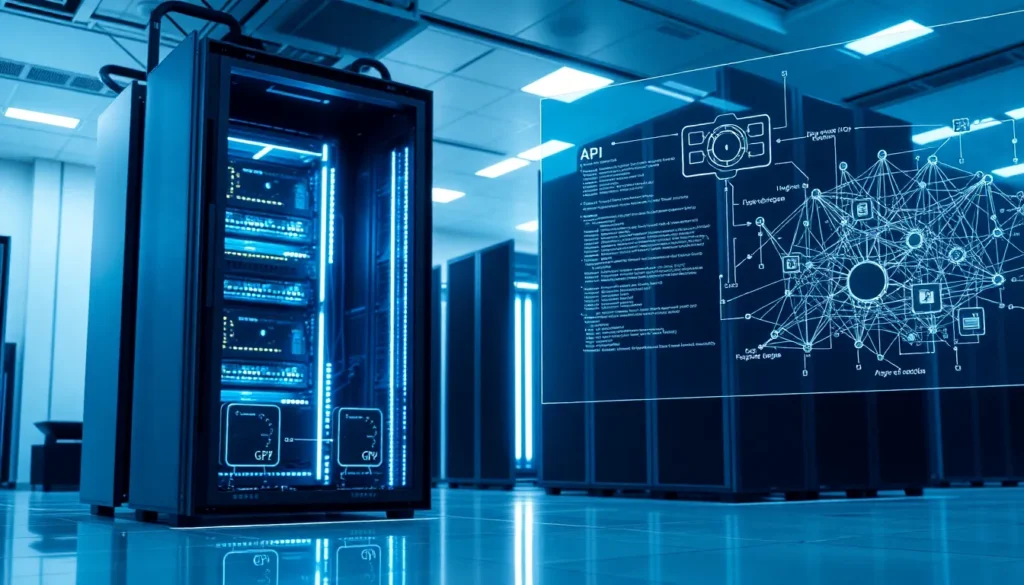
AI hardware refers to the physical components that run artificial intelligence workloads. These include specialized processors, memory units, and accelerators designed to handle intensive computations.
The most common types of AI hardware include:
- GPUs (Graphics Processing Units): Originally built for gaming, GPUs excel at parallel processing. Companies like NVIDIA dominate this space with chips specifically optimized for AI training and inference.
- TPUs (Tensor Processing Units): Google developed TPUs to accelerate machine learning tasks. They’re optimized for TensorFlow operations and offer high efficiency for specific AI workloads.
- FPGAs (Field-Programmable Gate Arrays): These chips can be reprogrammed after manufacturing. They offer flexibility for custom AI applications.
- ASICs (Application-Specific Integrated Circuits): Built for one purpose only, ASICs deliver maximum performance for specific AI tasks but lack versatility.
AI hardware matters because traditional CPUs struggle with the massive parallel calculations AI models require. A single deep learning training run might involve billions of mathematical operations. Specialized AI hardware handles these operations faster and more efficiently than general-purpose processors.
The AI hardware market has grown rapidly. Data centers now invest billions in GPU clusters to train large language models. Edge devices like smartphones include dedicated AI chips for on-device processing. This hardware foundation makes modern AI applications possible.
What Is AI Software?
AI software encompasses the programs, algorithms, and frameworks that enable machines to learn and make decisions. While hardware provides the muscle, software provides the brain.
Key categories of AI software include:
- Machine Learning Frameworks: Tools like TensorFlow, PyTorch, and JAX help developers build and train AI models. They handle the complex math behind neural networks.
- Pre-trained Models: Ready-to-use models like GPT, BERT, and Stable Diffusion save developers from starting from scratch. They can be fine-tuned for specific applications.
- AI Platforms: Cloud services from AWS, Google Cloud, and Microsoft Azure offer complete AI development environments. They combine tools, compute resources, and deployment options.
- Inference Engines: Software like TensorRT and ONNX Runtime optimizes trained models for production use. They make AI applications faster and more efficient.
AI software determines what an AI system can actually do. The same hardware running different software produces completely different results. A GPU cluster might train a language model one day and a computer vision system the next. The software defines the task.
Developers also rely on AI software for data preprocessing, model evaluation, and deployment. These tools turn raw data into training datasets, measure model accuracy, and push finished models into production applications.
Core Differences Between AI Hardware and Software
The AI hardware vs software comparison reveals several fundamental differences. Understanding these distinctions helps organizations plan their AI strategies.
Physical vs. Digital
Hardware exists as tangible components you can touch. Chips, servers, and cables all occupy physical space. Software exists as code, instructions stored digitally and executed by hardware. You can copy software instantly, but hardware requires manufacturing.
Cost Structure
Hardware requires significant upfront capital investment. A single high-end GPU costs thousands of dollars. Building a training cluster can cost millions. Software costs vary widely. Open-source frameworks are free. Commercial AI platforms charge subscription or usage fees. Cloud computing lets organizations rent hardware and pay only for what they use.
Update Cycles
Software updates happen quickly. Developers can push new features, fix bugs, and improve performance through downloads. Hardware upgrades require physical replacement. Once you buy a chip, its capabilities are fixed (unless it’s an FPGA). This makes hardware decisions more permanent.
Performance Bottlenecks
AI hardware vs software performance issues manifest differently. Slow hardware creates hard limits, a weak GPU simply can’t process data faster than its architecture allows. Software bottlenecks often stem from inefficient code or algorithms. Optimizing software can sometimes double or triple performance on the same hardware.
Flexibility
Software offers far more flexibility than hardware. Teams can experiment with different models, frameworks, and approaches at low cost. Changing hardware means significant expense and potential downtime. This is why many organizations start with software optimization before investing in better hardware.
When to Prioritize Hardware Over Software
Deciding between AI hardware vs software investments depends on your specific situation. Here’s when hardware should take priority.
Training Large Models: If you’re building foundation models or training on massive datasets, hardware matters enormously. Training GPT-scale models requires thousands of GPUs running for weeks. No amount of software optimization can compensate for insufficient compute power.
Real-Time Applications: Edge AI applications like autonomous vehicles, industrial robots, and smart cameras need dedicated hardware. These systems can’t tolerate latency from cloud connections. On-device AI chips provide the speed these applications demand.
Cost Optimization at Scale: Running inference on millions of requests daily? Specialized hardware like TPUs or custom ASICs can dramatically reduce per-query costs compared to general-purpose processors. The upfront investment pays off through operational savings.
Software Often Comes First: For most organizations, software investment should precede hardware upgrades. Better algorithms, more efficient code, and optimized model architectures can deliver major gains without new equipment. A well-tuned model on modest hardware often outperforms a bloated model on expensive GPUs.
Cloud computing offers a middle path. Teams can rent powerful AI hardware on demand, avoiding massive capital expenditure while still accessing top-tier compute resources. This approach works well for experimentation and variable workloads.