Table of Contents
ToggleAI hardware forms the physical foundation of every artificial intelligence system. Without specialized processors and chips, machine learning models would take weeks to train instead of hours. Traditional computers simply can’t handle the massive parallel calculations that AI demands.
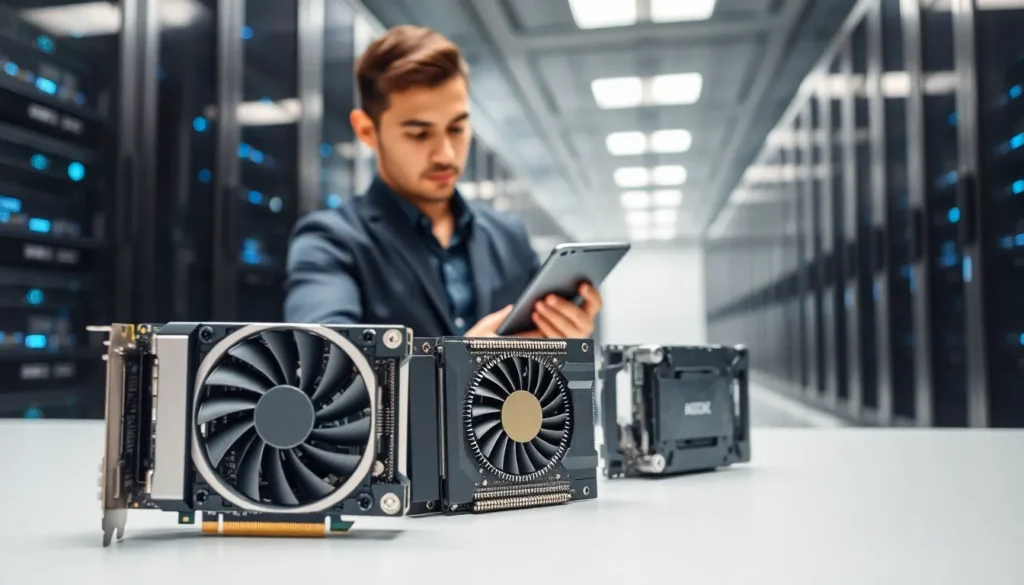
So what is AI hardware exactly? It refers to the physical components, processors, chips, and accelerators, built specifically to run AI workloads. These components process data differently than standard CPUs, making them essential for training neural networks and running inference tasks.
This guide breaks down the key types of AI hardware, explains how they differ from conventional computing equipment, and explores why this technology matters for the future of machine learning.
Key Takeaways
- AI hardware refers to specialized processors, chips, and accelerators designed to handle the massive parallel calculations required for machine learning.
- Unlike traditional CPUs that process tasks sequentially, AI hardware performs thousands of calculations simultaneously using thousands of smaller cores.
- GPUs, TPUs, and ASICs are the three main types of AI hardware, each offering distinct advantages for different AI workloads.
- Specialized AI hardware dramatically reduces training time—turning months-long projects into weeks—while improving power efficiency and cost.
- Major tech companies like Google, Apple, Amazon, and Tesla now design custom AI hardware to optimize their specific machine learning applications.
- Future AI hardware development will be shaped by chiplet architectures, photonic computing, neuromorphic chips, and potentially quantum processors.
How AI Hardware Differs From Traditional Computing
Traditional CPUs handle tasks sequentially. They process one instruction at a time, which works fine for spreadsheets and web browsing. AI hardware takes a completely different approach.
AI hardware performs thousands of calculations simultaneously. Neural networks require matrix multiplications across millions of data points. A standard CPU would choke on this workload. Specialized AI hardware handles these parallel operations with ease.
The key difference comes down to architecture. CPUs have a few powerful cores optimized for complex sequential tasks. AI hardware packs thousands of smaller cores designed for simple, repetitive math operations. Think of it like this: a CPU is a brilliant mathematician solving one problem at a time. AI hardware is an army of calculators working in sync.
Memory bandwidth also separates AI hardware from traditional systems. AI models need to move massive amounts of data quickly between memory and processors. Specialized AI hardware includes high-bandwidth memory systems that feed data to processing units without bottlenecks.
Power efficiency matters too. Training large AI models consumes enormous energy. AI hardware achieves better performance per watt than general-purpose processors, which reduces costs and environmental impact.
Key Types of AI Hardware
Several categories of AI hardware dominate the market today. Each type serves specific purposes and offers distinct advantages.
Graphics Processing Units (GPUs)
GPUs started as gaming components but became the backbone of modern AI. NVIDIA leads this space with products like the H100 and A100 chips. AMD and Intel also produce competitive AI-focused GPUs.
GPUs excel at parallel processing. They contain thousands of cores that handle matrix operations efficiently. Most AI research labs rely on GPU clusters to train their models. The flexibility of GPUs makes them popular, developers can reprogram them for different AI tasks without buying new hardware.
Cloud providers like AWS, Google Cloud, and Microsoft Azure offer GPU instances for AI workloads. This accessibility helped democratize AI development.
Tensor Processing Units (TPUs)
Google created TPUs specifically for AI workloads. These chips optimize tensor operations, which form the mathematical basis of deep learning. Google uses TPUs internally to power Search, Photos, and other AI-driven products.
TPUs offer exceptional efficiency for specific AI tasks. They outperform GPUs on certain benchmarks while consuming less power. Google makes TPUs available through its cloud platform, giving external developers access to this AI hardware.
The trade-off? TPUs lack the flexibility of GPUs. They’re optimized for TensorFlow and similar frameworks, which limits their usefulness for some projects.
Application-Specific Integrated Circuits (ASICs)
ASICs represent custom-built chips designed for particular AI applications. Companies like Cerebras, Graphcore, and SambaNova build ASICs for machine learning. These chips sacrifice general-purpose functionality for maximum performance on targeted tasks.
ASICs deliver the best efficiency for their intended use cases. A chip designed specifically for inference can outperform any GPU at that task. But, developing ASICs requires significant investment and time.
Many tech giants now design their own AI hardware ASICs. Apple’s Neural Engine, Amazon’s Inferentia, and Tesla’s Dojo chip all fall into this category. This trend reflects how important specialized AI hardware has become.
Why AI Hardware Matters for Machine Learning
Machine learning success depends heavily on AI hardware. Better hardware means faster training, larger models, and more practical applications.
Training time directly impacts innovation speed. A model that takes six months to train on standard hardware might finish in two weeks on specialized AI hardware. Researchers can test more ideas, iterate faster, and push boundaries further.
Model size has exploded in recent years. GPT-4, Claude, and similar large language models contain hundreds of billions of parameters. Only advanced AI hardware can train and run these massive systems. Without continued AI hardware improvements, progress in large models would stall.
Cost efficiency affects who can participate in AI development. Better AI hardware reduces the electricity and computing costs needed to train models. This matters for startups, academic researchers, and smaller companies competing against tech giants.
Inference, running trained models on new data, also demands good AI hardware. Self-driving cars need to process sensor data in milliseconds. Voice assistants must respond instantly. Real-time AI applications require AI hardware that delivers quick, consistent performance.
Edge deployment brings AI hardware closer to users. Instead of sending data to distant servers, devices can run AI locally. This requires compact, efficient AI hardware that fits in phones, cameras, and IoT devices.
The Future of AI Hardware Development
AI hardware continues to advance rapidly. Several trends will shape its development over the coming years.
Chiplet architectures allow manufacturers to combine multiple small chips into larger systems. This approach improves yields, reduces costs, and enables more flexible designs. AMD and Intel already use chiplets in their products. AI hardware will increasingly adopt this method.
New materials may replace silicon eventually. Photonic computing uses light instead of electricity to perform calculations. Neuromorphic chips mimic biological neural networks. These experimental approaches could dramatically improve AI hardware performance and efficiency.
Integration between hardware and software will tighten. Companies now co-design AI hardware and machine learning frameworks together. This coordination squeezes more performance from every chip.
Quantum computing represents another frontier. Quantum processors excel at certain calculations that classical computers struggle with. While quantum AI hardware remains experimental, it could transform machine learning in the long term.
Geopolitics also influences AI hardware development. Export restrictions, supply chain concerns, and national security considerations affect where chips get manufactured and sold. Countries increasingly view AI hardware as strategic technology.
The demand for AI hardware shows no signs of slowing. As AI applications spread into healthcare, transportation, manufacturing, and daily life, the need for powerful, efficient AI hardware will only grow.